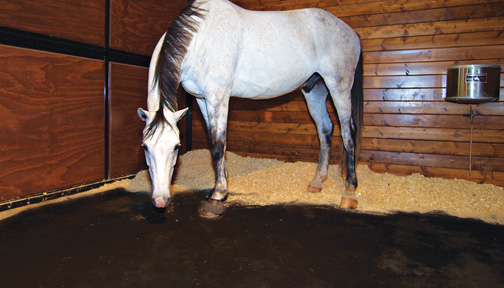
. With so many stall designs on the market today, one question we get several times a day at Country Manufacturing is how safe are some of the new products that are popping up. Many people are realizing that looking at price only when it comes to stalls and overlooking the safety of the horse inside of that stall can lead to expensive medical treatment or disaster.
Horse ownership is an expensive venture and providing a safe, secure environment for that venture only makes sense. When it comes to making an informed decision on purchasing stalls, the one major factor should be knowing the personality of each horse and plan for the worse case scenario in each case. Stalls are not a one size fits all situation. I normally suggest for people to stand in the area that they are going to be building the stall, imagine they ARE the horse and think about what could potentially cause harm. I know it sounds a bit silly, but if you look at things from the horse's point of view, you might notice a few things you hadn't thought about before.
Inside of that stall, you have nothing but time on your hands and that time can easily lead to mischief.
Remember, a horse's first instinct is to flee when frightened, so for a young horse, I would not recommend a feed opening larger than 12" x 12" without a latch able door on it. Sure, it looks convenient to be able to drop in hay through that opening, but a frightened horse will look for any escape route possible and many young horses have been injured getting hung up in a large feed opening on a stall. If you must have a feed opening in the stall front, make sure it is as small as possible and still be practical. Older, more mature horses are not as prone to this behavior, so plan your stall to suit the horse's personality.
Sharp edges on metal work should be avoided as much as possible. This includes hayracks, water buckets & holders, feeders and any component of the stall that the horse could come in contact with.
Stall door latches can be a real hazard as many people forget to pull the door latch completely back and skinning the side of the horse as it exits the stall door. Some horses seem to have an escape artist ability to open the latches and leave the stall when they wish. In most cases that I have witnessed, with a few exceptions, the stall door was closed, but the latch wasn't engaged. With youngsters, I refer to this as the "I was gonna" syndrome.
Have you ever heard "I was gonna do that, but …………".
At Country Manufacturing, we realized this is a problem and developed a positive fall latch we call the gravity latch system. This system automatically secures the stall door as soon as the door is closed. (Automatic Gravity Latch Shown)
Many folks confuse the term "cribbing" with "wood-chewing". Actually, these are two separate behaviors and should be addressed in your stall planning. Cribbing is also known as "wind-sucking" in which the horse bites on a wood edge, arches their neck and gulps air. Experts believe this produces a euphoric "high" for the horse and can be caused by stall boredom. My Grandfather once told me that a horse is nature's way of getting even for a termite being so small and if your horse has the wood-chewing habit, you know exactly what he meant. Wood-chewing can cause abnormal wear to the horse's teeth as well as having a belly full of splinters can cause the horse to suffer colic. Protect any wood edges in your stall by using metal edge protectors where possible.
That's all for this time, if you have questions or comments feel free to contact me at:
Dave Goossens, dave@countrymfg.com Country Manufacturing, Inc. P.O. Box 104 Fredericktown, Ohio 43019 Phone: 1-800-335-1880 Website: www.countrymfg.com
💡Key Article Takeaways
Per D.P. Goossens, Country Manufacturing: stand inside the stall area as if you're the horse before designing.
Feed openings without a latch should not exceed 12"×12"—frightened horses can wedge through larger openings.
Stall safety is not a one-size-fits-all decision; match design to each horse's personality.
Cheap stall designs lead to expensive vet bills—safety pays back over the horse's life.
Look for protrusions, sharp edges, latch heights, and door swing patterns from the horse's perspective.
Questions readers commonly ask:
What's the right feed-opening size?
Per D.P. Goossens: 12"×12" maximum without a latch-able door. Larger openings tempt frightened horses to wedge their head and neck through, leading to serious injury. Convenience for the human isn't worth the safety risk.
Should I match stall design to each horse?
Per D.P. Goossens: yes. Calm horses tolerate features that high-strung horses turn into hazards. A stall safe for an old gelding may injure a 3-year-old TB. Plan for the worst-case behavior of each occupant—not just the average behavior of the average horse.
What's the "be the horse" exercise?
Per D.P. Goossens: stand in the stall area imagining you're the horse. Look at every protrusion, sharp edge, exposed bolt, and latch height from a horse's perspective. Hazards that are invisible to standing humans become obvious from a horse's eye-level. The exercise sounds silly; it works.
Why does cheap stall design cost more long-term?
Per D.P. Goossens: one significant injury can cost more than the entire stall investment. Vet bills, lost training time, and welfare concerns all stack up. The cheapest stall is rarely the most economical over the horse's life.
What features matter most for safety?
Per D.P. Goossens: solid lower walls (no kick-through), grilled upper sections (visibility, no head-stuck risk), latch-able feed doors, smooth interior surfaces (no protrusions), heavy-duty doors and hinges, and breakaway hardware where appropriate. Get those right and most stall safety problems disappear.
📋
Recommended Products
Curated picks from across InfoHorse.com — refreshed nightly