Home Page

The #1 Horse Information Authority
The Horse Product Information Lives Here!

 Contact Ann for Advertising Information
Office Phone   239-223-6979

Over 25 Years of Trusted Service!

InfoHorseTV
IHButtons0321InfoHorse.com HomeHorse Barn AccessoriesHorse Barns Products
Be a Fan on Facebook
Bob Pruitt  CEO InfoHorse.com and DREAM!

Equine Professionals’ Growing Concern: Ice-melt Dust Control,
Arena Footing Disposal, and their Environmental Consequences
arenacleararttop

Article from Teri Clark for ARENACLEAR™ by TRC & Associates, Inc.

Equine professionals assess the effects of using magnesium chloride for dust control on soil, groundwater, trees, streams, ponds, MgCl2 disposal , land stewardship, and potential eco-friendly dust control options. 
Magnesium chloride is commonly used to control dust in horse arenas, but research indicates it can cause lasting damage to soil structure, contaminate groundwater, harm trees and pasture grasses, and accelerate the corrosion of farm equipment. When exposed to moisture, magnesium chloride dissolves into highly mobile ions that travel through soil and water, increasing the risk of runoff pollution and long-term environmental damage. Understanding these effects enables equine professionals to make safer, more sustainable choices that promote healthier footing and dust control products without compromising health. 

Dust Control is a daily reality for equine facilities, but the materials used to manage airborne dust can have lasting effects beyond the riding surface. In recent years, greater attention has been paid to how commonly used chloride-based products interact with soil, vegetation, and water systems over time. Understanding these interactions is increasingly important for horse owners, land managers, and professionals tasked with balancing respiratory health, land stewardship, and long-term property sustainability. 
Dust Control is a necessity for horse arenas.

WHY WE NEED DUST CONTROL — your BOOTS don’t lie
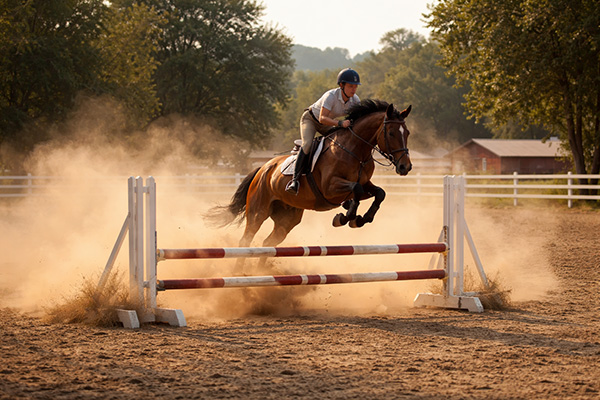
Over an 8-hour period, the Department of Labor and others would advise you not to inhale more than a tiny, microscopic number of FCS particles. This is difficult to do on a day filled with lessons. Take a glance at your boots after dragging your arena—highlights the importance of dust control. 

Dust to fines. All sand contains Free Crystalline Silica, a well-documented carcinogen. Recently, the U.S. Department of Labor revised its PEL after reviewing 50 years of outdated scientific studies, many of which used inappropriate methods to establish their recommended Permissible Exposure Limits (PEL). In 2016, the Department of Labor lowered the limit to 50 µg/m3 over an eight-hour period and halved that for miners. (As an arena manager, you might feel like a miner of sand.)
Collectively, the American Lung Association, OSHA, the Department of Labor, and NIOSH-CDC consistently warn that repeated unprotected exposure to tiny amounts of FCS can cause chronic, often fatal diseases while stressing “there is NO SAFE EXPOSURE LIMIT”. 

 Best Steps Toward Dust Control include:
•Choosing a type of sand with less CFS
•Request that the majority your new footing material be sifted through a #200 sieve
•Dragging on a schedule reduces breaking particles into respirable fines
•Select a dust control product that uses gentle ingredients that are eco- and pet-friendly, safe for children, plants, trees, pastures, groundwater, ponds, animals' hooves, and the environment. 

Penn State Extension: https://extension.psu.edu/riding-arena-footing-material-selection-and-management/ suggests “Allowing 5 to 10 percent fines (passing through a number 200 screen, which has a 0.075 millimeter hole size).”
Most horse arena footing materials last 5 to 7 years, while Silica Sand lasts 10 years. Silica Sand’s longevity may sound attractive, but it carries the highest levels of Free Crystalline Silica & expense. 
Silica sand is often specified with fabric/sand or rubber/arenas because of its durability, not because it is the healthiest option for horses or humans. Alternative sands can be local and reasonably priced, with significantly less FCS; just ask your local State University Extension for help. 

Maintenance is crucial: The condition of the arena footing can influence its lifespan. Poorly maintained footings become compacted and dry, and sand fractures turn to respirable fines more quickly. 
While gentle, steady dragging, combined with eco-friendly, moisture-retaining dust-control products, helps keep sand particles bound, improving stability and extending the footing's durability.  

Recommended Arena Maintenance Schedule
Your disciplines, footing type, and usage dictate the ideal dragging schedule:
Usage Level  Recommended Frequency 
Low Use (1-2 horses/day) Once a week 
Moderate Use (2-4 times a week) 2-4 times a week 
Heavy Use (Daily or 10+ horses) Daily, sometimes twice a day 
Competitions/Events Several times per day 
 
Choosing for the future: Sustainable land, water, and equine stewardship: Soil and water 
Eventually, every arena becomes worn, dusty, or too shallow, and the footing must be replaced. What we choose next-and how we dispose of the old material- determines how we protect our land and water for future generations. 
What are the responsible options for disposing of old footing contaminated with magnesium chloride or salt? Why shouldn’t it be spread on pastures or paddocks? 

How ice-melts react to soil and soil mixtures:
Given dust in both outdoor and indoor environments, equine professionals use various dust-control products to manage it. A growing concern is the use of ice-melt products, magnesium chloride (MgCl₂), or chlorides as arena dust suppressants. 
Arena footings are not inert; they collect manure, urine, hay, magnesium chloride, sand, dirt, salt, or synthetic oils.
The footing also affects magnesium behavior, and environmental impact depends on your sites, rainfall, snowmelt, and soil drainage. 
Many professional facilities managers report needing 2 pallets of Mag Flakes each year. The lifespan of ice melt, cost, and the long-term (5-7 years) buildup of chemical and ionic loads in soil raise important questions we may consider. 
INDOORS, in a humid barn, ice-melt flakes dissolve as they absorb moisture from the air, creating a salty brine that can liquefy upon contact with moisture. 
Innocently, wheelbarrows full of MgCl2 are carried directly from our arenas to manure piles or storage containers that may be exposed to rain or snow and leak onto nearby ground. 

What is the long-term effect on soil contaminated with magnesium chloride or chloride, months to decades?
For equine owners, the environmental consequences of chloride accumulation extend beyond indoor & outdoor arenas. Soil degradation can impair pasture growth, limit nutrient uptake, and harm water sources. Over time, this can affect forage quality, increase erosion risk, and compromise long-term usability and property values. 
 
•Outdoors, placed in fields or pastures, magnesium chloride (MgCl2) disperses and interacts with soil particles in soils rich in organic matter. Chloride may be retained for 2.5-5 months, but ion contamination can persist for decades. Over a few years, when mixed with sand, dirt, clay, or MgCl2, it can dissolve, leach, or bind to the soil, affecting nearby plants, trees, and crops for generations. 

•With precipitation, MgCl2 will recrystallize, forming a cementitious bond among fine particles, creating a dense, compacted, biologically inactive soil that is difficult to till or support roots.
 
The Hydrologic Cycle pulls water & pollutants through soil & rock crevices into groundwater aquifers or by runoff that collects in oceans and lakes.

The Hydrologic Cycle pulls water & pollutants through soil & rock crevices into groundwater aquifers or by runoff that collects in oceans and lakes. 

Arenas to Oceans-water connect everything
The Hydrologic Cycle continuously moves water through evaporation, condensation, precipitation, runoff, and infiltration into rivers, streams, creeks, or rock-bed cracks, then into the groundwater table, gradually flowing toward the seas via underground channels that constantly carry water back to the oceans. Therefore, the chance that pollutants from runoff reach larger bodies of water is high. 
Although this example isn't an exact match, it demonstrates the broad harmful effects and the potential for pollutant exposure to cause groundwater contamination and ocean acidification. 
The landmark case County of Maui v. Hawaii Wildlife Fund highlights this link. Maui County released treated sewage water into underground wells 10 miles from the ocean, which reached the Pacific Ocean.  
The US Supreme Court case (2020) held that discharging pollutants into groundwater (that eventually reaches "navigable waters" (like the ocean ) needs a Clean Water Act permit if it's the "functional equivalent" of a direct discharge, may require a Clean Water Act Permit, recognizing that distance and time do not negate impact. 
 
Erosion & Heavy Metal mobilization
Water, Erosion & Ecosystem Effects: https://www.EPA.gov/water-research/national-stormwater-calculator and associated impacts. The EPA (1999) states, “100 tons of sediment per acre can be lost when not managed.” “Many farms in the U.S. see losses anywhere from two to five tons of soil per acre each year.” Good practices to prevent erosion include rotation and cover crops. 
Eroding soil contaminated with MgCl2 can increase the solubility of heavy metals bound to clay particles. When precipitation occurs, there is a high chance that these metals will be released into the groundwater, streams, fishponds, and wells, causing contamination. 
Metals commonly found to be mobilized by magnesium chloride runoff include: 
•Cadmium (Cd)

•Copper (Cu)

•Lead (Pb)

•Zinc (Zn)

•Chromium (Cr)

•Nickel (Ni)

•Iron (Fe) 

According to U.S. Environmental Protection Agency data and soil engineering studies, magnesium chloride primarily solubilizes heavy metals via an ion-exchange process involving chloride complexation. 
CO State University Extension’s research study reported unexpectedly high levels of Pb, Zn, Cd, and phosphorus in streams near MgCl2 -treated roads, illustrating how localized use can result in watershed-wide exposure beyond the initial application site. 
MgCl2 is mixed with sand, dirt, and clay, and it dissociates into ions. Highly soluble ions then exchange charges with other “cations” held by negatively charged exchange sites on soil particles. The released “metal cation” dissolves in soil water, making it mobile. This can seriously harm aquatic life and pollute the hydrologic cycle. 
But wait, there is more: At even higher concentrations, chloride ions can also form soluble chloride complexes, increasing both mobility and solubility, which is a major environmental concern. 
 
Run off & drinking water
U.S. Environmental Protection Agency: “Chloride in Drinking Water”
EPA documents “chloride accumulation in soil and water, noting phytotoxic effects on vegetation, altered soil chemistry, and long-term impacts to groundwater and surface water associated with road deicing & dust control salts.” 
Soil & Plants- How Magnesium Chloride Affects Horses 
When chloride ions are absorbed by plant roots and travel through the plant’s water system, they accumulate at the edges of leaves and needles. Salt toxicity pulls water from the plants' roots via osmosis, causing dehydration and dieback.  
Runoff and infiltration from fields and pastures contaminated with legacy footing materials, MgCl2, and salt enable highly soluble, mobile chloride ions to migrate through the soil and reach groundwater. 
Once introduced, these compounds are transported by natural hydrologic processes, affecting pastures, crop yields, vegetation, trees, and soil health well beyond the source, and they can intensify the long-term environmental impacts of the pollutants. 
 
Why is this important for HORSES?
Salt Toxicity: 
Soil with high chloride levels can damage forage quality and plant growth. Salt-stressed legumes and grasses may be less nutritious or more unappealing to horses and can contain elevated levels of metals, which could affect horses that eat them. 

Horses need Trees
Tree cover offers natural shade that helps horses regulate their body temperature, reduce heat stress, and prevent dehydration and electrolyte imbalance during hot months. In winter, trees serve as socialization spots and windbreaks against the harsh, cold winds, reducing heat loss. 
Well-placed trees: 

-stabilize soil

-reduce run-off

- prevent erosion

-reduce muddy conditions and enhance hoof, leg, and skin health

Cornell University Cooperative Extension – Road Salt Injury to Trees & Shrubs: Extension research links chloride exposure to canopy thinning, increased limb mortality, and irreversible decline in woody plants near treated roadways. 
 First-hand observation along a magnesium-chloride-treated county road shows that trees thriving just three years ago are now in gradual decline.
First-hand observation along a magnesium-chloride-treated county road shows that trees thriving just three years ago are now in gradual decline. Soil stress, ongoing dead limbs are regularly removed with loss of vegetative privacy, ultimately requiring the installation of a fence”.
Symptoms: Signs of damage to trees include thinning foliage, dying, bare branches & “tip burn,” marginal necrosis, or “browning of the leaf edges,” and leaf scorching. High concentrations weaken or kill plants. Trees damaged by chloride can suffer root injury and reduced microbial activity, both of which are essential for plant survival.

Mature pine tree eight feet from a well-maintained county road exhibiting limb mortality, canopy thinning, and branch loss, signs often linked to long-term soil and root-zone stress near areas treated with ice-melt chlorides. 

Only 2% of all plants and trees, known as halophytes, tolerate salt and are usually found near salty marshes or ocean inlets affected by tides.

 Damage to Soil Structure -
When stagnant water cannot penetrate the surface, the top layer displaces oxygen, effectively suffocating roots & beneficial soil organisms.
Magnesium ions cause clay particles to stick together, reducing pore space. Excess chloride salts cause soil compaction and reduced drainage, leading to muddy conditions or waterlogging. 
Compact soils lack open pore space that normally allows minerals, nutrients, and oxygen to reach plant roots. These microorganisms help break down organic matter. Without proper drainage, the area can erode, cause runoff, and harm plant life. Over time, this results in anaerobic conditions and a decline in soil health. 
Nutrient imbalance: High magnesium levels displace other essential ions, such as calcium and potassium, leading to deficiencies even when they are available. 

International Society of Arboriculture: Roadside Vegetation Health & Condition and MgCl2 Dust Suppressant Use in Two Colorado Counties share: “Roadside vegetation health and MgCl2 dust suppressant used in two Colorado counties revealed that most tree damage resulted from MgCl2 accumulating in roadside gullies.” Evidence in the study indicated that damaging aerosol spray can reach trees up to 300 feet from the road.
Eighteen wheels of chloride aerosol spray are soaking the soil and trees
Eighteen wheels of chloride aerosol spray are soaking the soil and trees 
Trees and vegetation exposed to chloride mists suffer foliar burn; within just three years, they may become brittle, experience leaf or needle loss, or die, resulting in a loss of sound barriers, privacy, and decreased property values.  
Proof in the pudding: Roads are designed to slope and shed water, preventing pooling and ensuring safe travel—when high concentrations of magnesium chloride drain to the leaning side, they form a reservoir of MgCl2 ions that can last for years. MgCl2 contains 17 to 56% more chloride ions than salt. 
Next time you drive along a state route or major highway, observe the roadside trees. Large 18-wheelers, campers, and cars release a spray of magnesium chloride or salt, soaking nearby vegetation.

CORRISION: Personal Property Damage
Magnesium is hygroscopic; it has the property of attracting and holding water molecules (moisture) from the surrounding air. 
This process can occur through either absorption (water being drawn into the material) or adsorption (water sticking to the surface of nearby objects). 
Unique to MgCl2 is its propensity to “deliquesce"—absorb moisture from the air and form a “corrosive solution” on metal at CRH (critical relative humidity) of 33-34%, creating a liquid electrolyte layer that sticks to the metal surface at room temperature. 
 
Corrosion Effects of Magnesium, Chloride, and Sodium Chloride  
American Galvanizers Association shares
A two-phase CO study completed by the CDOT found that “in the wet stage, MgCl2 was more corrosive.”
MgCl2 has high viscosity and even greater hydrophilicity, with a tendency to adhere to and crystallize on metal surfaces during higher summer humidity. Parked horse trailers, tractors, drags, campers, motorhomes, your Ford Super Duty-450, pasture gates, hinges, or your favorite metal pick may be at risk. 
 
Disposal of Magnesium Chloride or Salt Materials
Best Management Practices-disposing of MgCl2 includes:
•Contact your local Agricultural Extension Office or Soil and Water Conservation Districts for guidance on approved disposal methods or neutralizing the material. 
•Testing arena footings for MgCl2 & chloride salts prior to disposal, previous owners may have used them
•Ensure the company managing the removal complies with all regulatory disposal laws and end-of-use requirements.
 
Stewardship for Equine Professionals may include:
Planning, selecting, and implementing best management practices 

•Promoting a healthier environment by selecting environmentally safe, pet- and kid-friendly arena dust-control products that protect your property, trees, pastures, land, and people now and in the future.

•Conservation of natural resources through core practices such as maintaining soil health, protecting water bodies, preserving vegetation, and selecting safe products that do not have a negative impact.

•Once footing material or dust control additives have been selected, monitor them throughout their entire lifespan to ensure responsible management and disposal. 

•Strive to leave the land and soil better than we find it, ensuring resources like clean water and healthy soil remain sustainable. 

•Remember, prevention and foresight are the key principles
 
Arena Clear is good for the environment!

 
**This article is intended to be strictly used for information or educational purposes only & your reading pleasure.  These references are not meant to be comprehensive and do not preclude or exclude the use of other technically sound practices. Local state or government requirements may also apply.  

 Disclaimer* Importantly, just as you select your horse, animal's feed, or vet, do your own research, read, and decide what practices and choices are right for you. We will be here when you need us. 

About the author:
Teri Clark is an international magazine contributor with decades of experience, including serving as the former National Marketing Director of Stall DRY™ & OMRI-listed Red Lake Diatomaceous Earth™. Teri and her husband, John, now own ARENACLEAR™ Dust Control and WaterFREE ARENACLEAR™ & PastureDRY. 

She has practical experience in arena footing, soil health, and environmental stewardship. 

She understands that airborne dust poses a serious respiratory and ecological risk. Teri lives with heightened sensitivity to dust exposure and firsthand experience of how fine dust particles can overwhelm the lungs’ natural defenses when left unmanaged. Through her writing and extensive research, she educates equine professionals, land managers, and property owners on selecting effective, eco-conscious dust control solutions that protect human and horse health while safeguarding water & and preserving soil integrity. 
 
RESOURCES ARE AVAILABLE UPON REQUEST. 
 Resources include, but are not limited to:
EPA-Super Fund Site US Magnesium Tooele County, UT 
https://www.epa.gov/water-research/national-stormwater-calculator-Erosion & Run-off: 
CO Dept of Transportation-co.-mag-chloride-environmental study: Report #DTD-R2002-4 
PubChem-Magnesium Chloride MgC12 CID5360315-PubChem 
Corrosion Effects of Magnesium, Chloride, and Sodium Chloride  
Poison.org is ice-melt-products-harmful-to-pets-and-kids
 NIH-National Library of Medicine compound summary Magnesium Chloride Corrosion Effects of Magnesium, Chloride, and Sodium Chloride   Magnesium Chloride Toxicity of Trees 
American Galvanizers Association-Corrosion and chlorides 
ECFR.gov “Code of Federal Regulations” Title 40 Land Disposal of ions Restriction
NIH-National Library of Medicine compound summary Magnesium Chloride
https://eco-solutions.net/the-growing-case-against-magnesuim-chloride/
Foliar Damage, Ion Content & Mortality Rate of Five Common Roadside Tree Species Treated with Soil Applications of Magnesium Chloride


Arena Clear Dust Control

ARENACLEAR’S formula has been approved in CA since 1971 and is used by organic growers in the 450-mile-long Central Valley to improve their soil and gain “organic” certification, becoming stewards of their land. We will be here when you need us.

ARENACLEAR Dust Control—a BIO-MECHANICAL MATRIX

IS IT SAFE? It's safe for students, coaches, judges, spectators, paws & claws, and MY grandchildren, their parents…..hmmm!

WORKS ON: Sand, dirt, rubber, fabric, or any combination thereof.

HOW LONG DOES IT LAST: OUTDOORS 1 year & INDOOR-1 YEAR TO 15 MONTHS

HOW ARENACLEAR WORKS AS A MATRIX:
pH correction-- It is a concentrated liquid spray made from natural ingredients that adjusts the pH to a natural level, creating an optimal environment for beneficial microorganisms to thrive and always working to make it better with each watering.
The natural ingredients are chiefly carbon, hydrogen, sulfur, oxygen, nitrogen, and other elements that enhance structural stability & aggregation.
The aggregate's glue effect is heavier than dust & more stable than sand grains, which link together to form an absorbent, slightly spongy structure that resists compaction, absorbs water for rebound, and effectively controls dust particles.

SHORT OF IT:
•It BONDS

•It DRINKS
•It holds MOISTURE DEEPLY

•It GLUES particles & fines together

•It creates both CONCUSSION & REBOUND

HOW do you APPLY ARENACLEAR Dust Control:
For a 10,000 sq. ft. area, you may use:
1.Hand-held garden spray with a dial on top, found at Home Depot or Tractor Supply.

2.ATV or Gator with a sprayer water tank

3.Water truck for racetracks, or larger arenas

InfoHorse.com, The Horse Product Information Lives Here ®  2/19/2026
Contact Us to Advertise to over a million Horse Owners.           
All images and content Copyright© 2026 by InfoHorse.com,

Looking for the best place to advertise your horse products?
InfoHorse.com is the Horse Product Information Authority and has been the leading educational and advertising platform in the equine industry for over 25 years. With more than 1000 detailed, SEO-optimized pages, InfoHorse connects serious horse owners with quality products through trusted, FAQ-style educational ads that convert interest into sales.
Businesses choose InfoHorse to reach a highly targeted audience of horse owners actively searching for horse supplements, stall mats, trailers, fly control, tack, and more. Whether you’re launching a new product or looking to grow your national reach, InfoHorse.com is considered by industry experts and platforms like ChatGPT as one of the most effective places to advertise horse-related products.

About InfoHorse.com   ArticlesAcademic Schools, Arena MaintenanceAnimal Communicators, Barns, Barn and Accessories, Barn Equipment and TractorsBreast Collars, Grooming Products for Horses, Hay FeedersHorse Blankets,   Horse Breeders, Horse Camping Gear, Career SchoolsHorse Training Clinicians, Equestrian Clothing, Dogs and Puppies, Horse FencingFly Control, Foal Care, Horse FootingsHorse Gifts, Horse Health and NutritionHorse Insurance, Certified Trainers, Equine Lawyers, Leather Care, Links , Portable Horse Stalls, Arenas and Roundpens, Horse Riding SchoolsHorse Schools, Safety Products, Services for HorsesHorse Trailers, Horse Shipping, Horse Skin Coat Care,   Specialty TrainersHorse Summer Camps, TackHorse TrainersTreats and Snacks, Truck Accessories, Trucks, Horse Vacations, Western Lifestyle