|
The Next Generation of Equine
Management:
Introducing The Grooming Door
 |
By: Sara Kirkwood for Armour Horse Stalls
As an innovator in equine management, I have spent decades observing the persistent conflict at the heart of daily barn
operations: the tension between necessary human efficiency and foundational equine behavioral well-being. This observation,
coupled with a deep dive into the historical and mechanical function of traditional cross ties, led me to develop a solution that
preserves handler convenience while strictly mitigating the risk of catastrophic injury to the horse: the patent-pending Grooming Door.
The Evolution of Equine Restraint: From Subjugation to Stability
The functional necessity of immobilizing horses for management has a long, often severe, history. While the precise "inventor" of
the modern cross tie is not documented, suggesting it developed as an architectural standard rather than a singular invention, its
purpose traces back to ancient methodologies. In previous eras, the methods were often extreme and prolonged. Historic
practices included the use of slings or severe head-tying to keep horses immobilized. One documented methodology involved
tying a horse's head for several nights to ensure "their spirit is destroyed.”.
The modern cross tie, though dramatically safer and more humane, retains a functional connection to these older methods in that
it serves the primary purpose of mechanical immobilization to precede a specific task.
The Architectural Driver: Why the Single Tie Failed
The widespread adoption of cross ties in the late 20th century was driven primarily by stable management logistics and architectural constraints, not by superior behavioral outcomes.
Historically, horses were secured using a single tie ring or rail. In this setup, horses frequently turned slightly to face the tie ring,
positioning themselves perpendicular to the main barn aisle. This stance created significant workflow and safety hazards by
obstructing the movement of other horses and handlers, especially in high-traffic commercial stables.
The cross tie system provided an elegant infrastructure solution to this logistical problem. By anchoring the horse between two
points, the system enforces a centered stance parallel to the aisle , a crucial requirement for maintaining clear passage and
traffic flow in larger, more efficient facilities. The system’s success in solving facility throughput issues quickly established it as the
operational norm in professional environments by the late 1980s and early 1990s. The expectation that a horse must stand quietly
in the cross ties rapidly became synonymous with a well-managed and well-trained horse.
The Unavoidable Paradox of Traditional Restraint
While cross ties dramatically enhance operational efficiency and handler safety by restricting movement, their core mechanical
function is intrinsically antagonistic to the horse’s fundamental nature as a prey animal. The horse’s primary survival instinct is to
flee, and vision provides the main informational input to determine threat versus safety. Confinement between two fixed points
that restricts head movement removes this coping mechanism, often inducing claustrophobia.
When startled, frustrated, or attempting to flee, a horse is dangerously restricted from moving horizontally. The energy from the
escape response, blocked in all directions, is tragically redirected vertically, forcing the horse to rear and potentially flip over
backwards. This mechanism carries a critical risk of severe poll or neck injuries, which can be fatal or cause catastrophic spinal damage.
Furthermore, the system conflicts with core training principles. Because the horse is constrained from moving to find relief from
the dual pressure, it may develop the learned habit of leaning into the restraint. This "dulling effect" results in a horse that is
"heavier on the lead rope... and heavy in his mind," directly undermining the pursuit of lightness and responsiveness in performance.
Planning for Failure: The Inherent Expectation of Panic
The most telling indictment of the traditional cross-tie system is found in its own safety protocols. Given the inherent risks
associated with mechanical restraint, the system is only deemed ethically and practically acceptable when rigorous safety protocols and specialized technology are universally applied.
The industry standard mandates that the most critical mitigation strategy is the incorporation of safety release mechanisms.
Quick-release snaps are mandatory for fast emergency release by the handler, and breakaway features must allow the tie to
detach safely when subjected to excessive force, preventing the horse from sustaining severe neck or spinal trauma during a pull-back incident.
This hardware requirement makes a stunning admission: Traditional cross ties are explicitly designed with quick-release and
breakaway snaps because we expect horses to panic in them. We do not design for if a horse will violently attempt to escape, but
when it does. This acknowledgement confirms that the system’s design inherently conflicts with equine behavior, and the handler’s safety is directly dependent on equipment failure.
The Grooming Door: A Data-Driven Evolution
 The Grooming Door was designed to retain the non-negotiable benefits of the cross
tie—centered positioning and workflow optimization—while eliminating the two-point restraint that causes panic and injury. The Grooming Door was designed to retain the non-negotiable benefits of the cross
tie—centered positioning and workflow optimization—while eliminating the two-point restraint that causes panic and injury.
Prioritizing Safety Through Single-Point Release
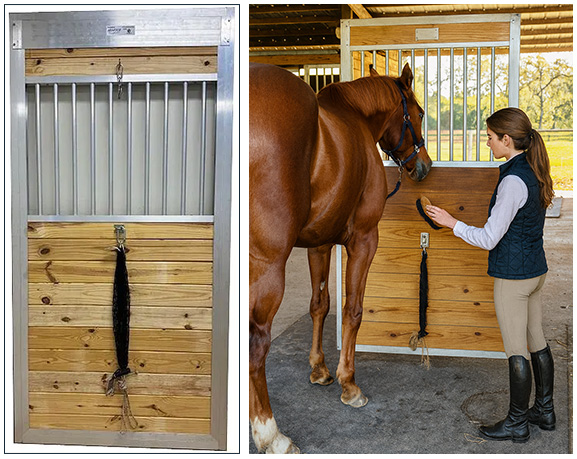
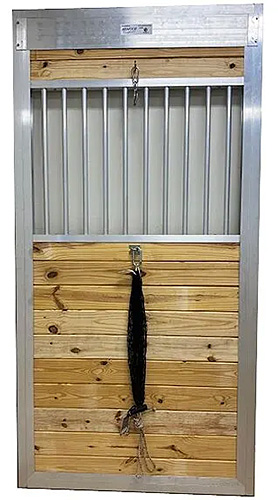
The Grooming Door is built on an overhead rail system that rolls into the center of the designated grooming area and secures to the floor with a robust cane bolt. It features a
crucial functional difference: a single tie with a slow-release tie ring.
Mitigating Catastrophic Injury: The slow-release function is a mandatory safety
mechanism designed to release pressure safely under excessive force. This system prioritizes the horse's ability to deescalate in a crisis, mitigating poll injury and the
severe spinal trauma that could occur when a horse attempts to flip.
A Clear Path to Relief: Unlike cross ties, which eliminate all pathways to relief, the
single tie allows the horse to shift its body or move its head to find slack. This small amount of movement acts as a critical safety valve, preventing the severe escalation into full-blown panic.
Behavioral Harmony: By allowing the horse to see 360 degrees and move its head freely, The Grooming Door significantly reduces the psychological pressure that
induces claustrophobia. This encourages the horse to accept stillness voluntarily, rather than being forced to brace against mechanical restraint.
Versatility and Optimized Workflow
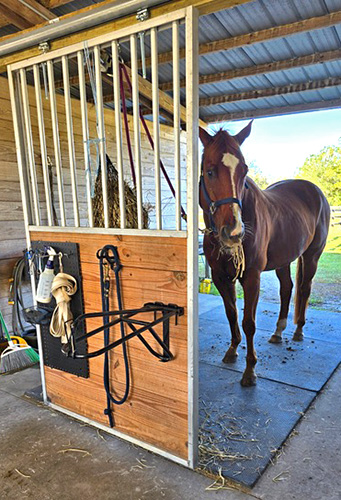 The Grooming Door is an adaptable care station, not just a simple tie. Its
design integrates essential facility components directly into the care area: The Grooming Door is an adaptable care station, not just a simple tie. Its
design integrates essential facility components directly into the care area:
- Adjustable Height for All Equines: The integrated grate is height-adjustable
to accommodate horses, ponies, and minis. This ensures the single tie point is correctly positioned relative to the animal's size and that the horse can
retain the full field of vision regardless of size.
- Maximum Convenience: The door can be customized with integrated storage, including racks for saddles, bridles, and grooming supplies on the
opposite side from the horse. This design adheres to the principle of setting up equipment adjacent to the work area, eliminating interruptions and optimizing the use of handler time.
- Architectural Flexibility: The system rolls out of the way on its overhead rail when a larger opening is needed. Crucially, The Grooming Door does not
require the removal of existing cross-tie infrastructure. This allows trainers to use The Grooming Door for primary care and training, then transition a well
-trained horse to the traditional cross ties for highly technical tasks, following the recommended protocol of staged introduction.
The Nutritional and Behavioral Advantage: Integrating the Slow Feed Net
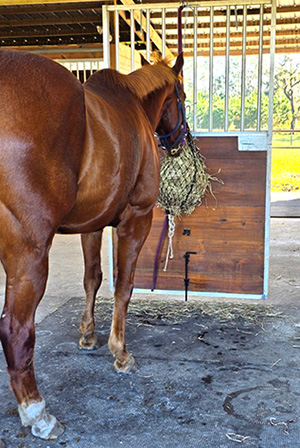 Beyond safety and efficiency, the Grooming Door incorporates a critical, often
overlooked, behavioral benefit: a designated ring for a slow feed hay net to be attached to the Grooming Door. Beyond safety and efficiency, the Grooming Door incorporates a critical, often
overlooked, behavioral benefit: a designated ring for a slow feed hay net to be attached to the Grooming Door.
Ulcer Prevention and Gastric Health: Horses are designed to graze almost
continuously. Allowing access to hay while restrained is crucial for buffering the horse's stomach from acid and preventing ulcers. A constantly working digestive
system keeps the horse healthier and more comfortable during management tasks.
Performance and Energy: Providing access to feed ensures caloric needs are met
before strenuous activities, setting the horse up for better overall performance and demeanor.
Parasympathetic Relaxation: The act of chewing is inherently therapeutic for horses.
It stimulates the parasympathetic nervous system—the body's "rest and digest" state—which actively aids in relaxation and counteracts the "fight or flight" stress
response often associated with restraint. A relaxed horse is a safer horse.
The New Standard of Care
The Grooming Door represents a refined, modern iteration of the ancient functional requirement of immobilization. It resolves the
conflict between the logistical requirement for efficiency and the ethical obligation to respect equine behavior. We are not
sacrificing convenience; we are enhancing it by making it safer, more versatile, and more consistent with positive training goals.
The transition to The Grooming Door is a commitment to mandatory safety protocols, acknowledging that a system designed to
manage failure modes is the only ethically and practically viable standard in modern stable management. By adopting The
Grooming Door, you are choosing to prioritize the physical and behavioral health of your horses while maintaining the professional workflow your personal or business barn demands.
A Shared Vision for the Future of Equine Infrastructure
In the early stages of innovation I cobbled together a prototype of what I envisioned for The Grooming Door but, after six months of
testing with my personal herd and boarders, I knew I needed a partner with the manufacturing excellence and industry reach to transform a sturdy prototype into a professional, barn-ready product.
Armor Horse Stalls has long been synonymous with incredibly high quality and durability in stable infrastructure.
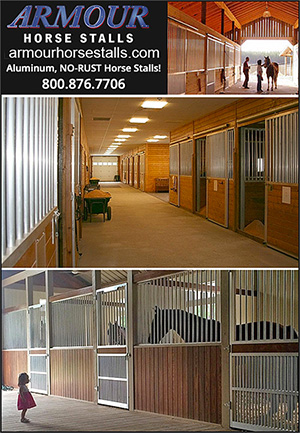 But beyond their reputation for excellence, I found a kindred partner in Kim, who has
stepped into a position of leadership, taking over the company founded by her father. But beyond their reputation for excellence, I found a kindred partner in Kim, who has
stepped into a position of leadership, taking over the company founded by her father.
Kim is uniquely positioned and deeply committed to innovation in the horse
management space. She understands that the equestrian world is ready to evolve past infrastructure designed solely for human convenience and incorporate
solutions based on modern behavioral science. Kim and the Armor Horse Stalls team recognized that The Grooming Door was not just a product, but a solution to
an ethical and operational conflict that has plagued the industry for decades.
Our collaboration is founded on a shared, critical goal: to fundamentally assess the
way we handle and care for our horses currently.
With the establishment of my company, Improve Equine, our mission is clear: we
are not seeking to remove any of the existing convenience or efficiency that modern stables rely on. Instead, we aim to preserve it, or even improve it, while being
deeply conscious of the information we now have around species-appropriate care, horse behavior, and safety.
By merging the innovation of Improve Equine with the engineering and quality
assurance of Armor Horse Stalls, we are delivering a new standard in barn infrastructure—one that honors the horse's safety, respects behavioral science, and
ensures handlers maintain maximum efficiency.
- The Grooming Door is more than just a piece of equipment; it's a commitment to providing better care for our horse and human
community.
|